What first sparked Annegret’s interest in research?
Annegret studied in Germany, where medical students are encouraged to get ‘hands‑on’ with research by participating in a PhD as part of medical training which includes spending significant time in the lab. Her inspiration was meeting a neuroanatomy professor whose teaching “blew her mind.” Learning how the brain controls the body along with the endocrine or hormonal system opened a door to a world she had not known about.
That fascination led her into the lab, studying a tiny part of the of the inner ear. She learned histology, immunohistochemistry and even electron microscopy.
By the time Annegret defended her thesis, she’d discovered not just a topic she loved, but a passion for research itself.
What were her biggest milestones?
One of Annegret’s defining moments came after moving to the UK for postgraduate training in ophthalmology. On discovering her German doctorate didn’t count as a PhD in the UK, she approached Professor Sir Peng Tee Khaw, a world expert in wound healing and our BRC Co-Director. From this meeting, and together with Prof. Maryse Bailly, Annegret developed a successful application for a Wellcome Trust Research Training Fellowship.
That fellowship provided her with three years of protected lab time, in her words “a rare gift for a clinician”, and ultimately a UK PhD. “It put me in good stead when I was applying for research grants later on,” she says.
How has the NIHR helped with her trials?
The coveted NIHR Senior Clinical and Practitioner Research Award (2024), gave Annegret 50% protected time to develop her research further.
In addition to protected time, the NIHR award provides training opportunities and the ability to build long‑term research programmes. Her current award supports both her scientific development and the groundwork for future clinical trials, the kind of work that simply isn’t possible without dedicated research time.
That time is now powering her work towards a major national effort to tackle one of the fastest‑growing eye health challenges, myopia (short sightedness).
Why myopia?
Annegret explains short‑sightedness is rising fast. In England, around 40% of young people are currently affected and in parts of East Asia it’s as high as 85%. Severe myopia in youth increases the risk of sight‑threatening problems later in life so it is of great benefit globally to look at prevention and cure.
The NIHR‑funded time is aiding Annegret build a network to prepare a major UK trial of optical and pharmacological treatments combined to slow the progression of myopia in children. This involves talking to families, optometrists, ophthalmologists, and crucially the children themselves about myopia and how they feel about using new treatments.
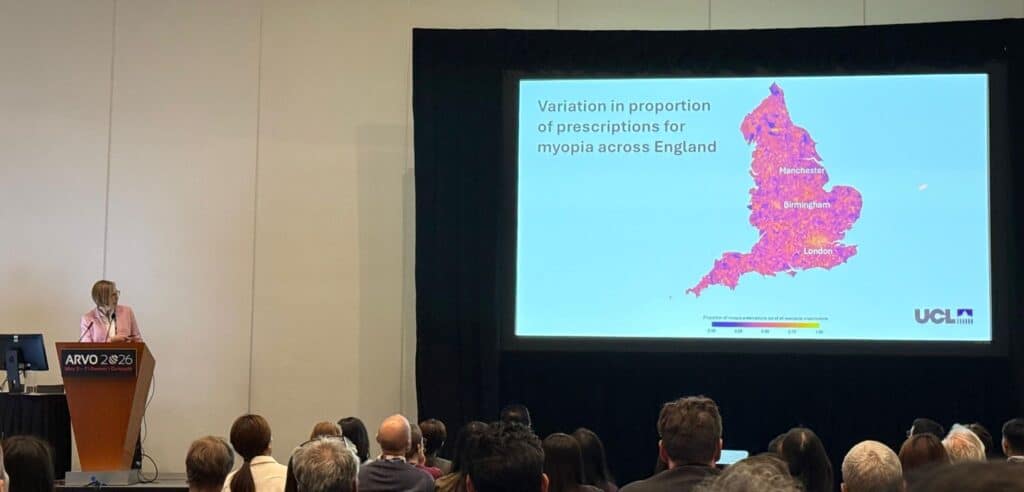
Recently, she has worked with epidemiologists (doctors who study population health) to analyse England’s national spectacle prescription database for children and young people. This has revealed regional variations in how common glasses for myopia are, and also that myopia is a big problem for children in poorer communities with little access to green space.
We can now say how many children have been prescribed glasses for myopia, and how it is linked with geospatial and socioeconomic factors.
She says
Two major papers from this work have been submitted for publication and were presented at ARVO, the world’s biggest vision‑science conference in the past couple of weeks.
How do patients and young people shape her research?
In 2019 Annegret helped establish the eyeYPAG (Young People’s Advisory Group for Eye and Vision Research) through our BRC. This is a group of young people she views as essential.
The young people in the group are trained to help review patient information sheets, co-write lay summaries and advise on study design. They help researchers understand what will and won’t work for other children in research settings. She says, “they pay back big time to the research community.”
Her current myopia project includes families from underserved communities in Tower Hamlets who struggle to access treatment that slow down myopia progression, as well as families who already use myopia control treatments. These research conversations have shaped everything from her trial design to her understanding the lived experience of wearing glasses as a child.
What is the biggest challenge when running clinical trials?
Annegret says there are two. When applying for funding the challenge is simply competition. Eye researchers must compete with cancer, heart disease, stroke, and other major health priorities that threaten life. Making the case for children’s eye health means showing how vision affects education, independence, employment, and lifelong wellbeing, as well as the cost to the NHS and wider society.
Secondly, funding recruiting children to studies is another big hurdle. Families face barriers to participation which include: taking time off work and school, travel time and costs, and also simply trust issues around medical research. Trials run during the working and school week which doesn’t suit most families. Opening up research visits on Saturdays does help, but staff availability on weekends is limited. – and kids have their activities too!
Despite these barriers Annegret finds the children themselves are often the most altruistic participants.
What advice does Annegret give to early career clinicians and researchers?
For clinicians, she recommends starting with data audits, service evaluations, manageable projects that build research skills and confidence.
What does the future of ophthalmic research look like?
For her, the future is all about networks of professionals; multidisciplinary teams that put children and families at the centre. Annegret works closely with paediatricians, orthoptists, optometrists, teachers, social workers, and the UK Myopia Consortium.
Because myopia treatments will largely be delivered by high‑street optometrists, collaboration across these sectors is important.
The final goal for her is clear: making research and treatments that accessible, child‑friendly, and grounded in real world needs.