The association was founded as a group of well-regarded American Ophthalmologists over a century ago in 1921, as the Association for Research in Ophthalmology and had expanded their membership to around 100 by 1945. In the 1960’s they instigated a big change, reflecting the growing trend towards science, and started welcoming more scientists and researchers.
This was concurrent with expanding their meetings to be multi-venue and multi-subject. The name changed to the Association for Research in Vision and Ophthalmology in 1968. It has since removed national borders and expanded its membership to include over 11,000 researchers from over 70 countries and is the most visited ophthalmic event in the world.
Our research colleagues generously took time during their busy conference schedules to contribute to this article. If you’d like to learn more about any of the projects listed below more detailed abstracts can be found on the ARVO website.
Below is a brief overview of Prof. Pearse Keane’s Artificial Intelligence (AI) Lab. For further detail, you can explore the full version on the INSIGHT’s website.
Foundation Models and Large-Scale AI Platforms
Following the creation of the world’s first foundation model in ophthalmology, RETFound, the lab has have been developing more powerful AI that can adapt to different real-world uses.
Dominic Williamson: Developed a new foundation model trained on OCT B scans that outperforms existing systems.
Eden Ruffel: Built on this model to predict how quickly age-related macular degeneration (AMD) will progress, enabling earlier identification of high-risk patients and outperforming existing systems, including RETFound.
Yilan Wu: Presented RETFound Plus, a next-generation longitudinal foundation model that learns from changes in retinal images over time to improve prediction of disease progression. The model also improves accuracy across multi-ethnic cohorts for both eye and systemic conditions, including stroke, diabetes, and myocardial infarction.
Yukun Zhou: Showcased a benchmarking study highlighting the importance of fairness evaluation of retinal age prediction models, demonstrating that models trained in one country can lose accuracy when applied to different populations.
AI for Disease Risk Prediction and Stratification
A major theme across the group is using AI and deep learning to support clinicians in identifying who will develop serious eye disease, and when, enabling more targeted, personalised care.
Paul Nderitu: Investigated whether analysing retinal blood vessels using deep learning can improve prediction of treatment needs for proliferative diabetic retinopathy (PDR).
Lie Ju: Developed an evidence-based AI framework for glaucoma screening and early detection, uniquely tailored to fit a clinical referral system.
Hyunmin Kim: The emerging field of Oculomics uses eye scans to answer questions about the whole body. Kim explored whether OCT or fundus imaging is best at predicting systemic disease.
Technical Advances: AI Tools and Methodology
Alongside clinical applications, the group continues to advance the technical methodologies and tools that underpin robust, scalable medical AI.
Justin Engelmann: Presented two technical contributions at ARVO this year. His first study introduces DABS (Device Agnostic Boundary Segmentation), an easy-to-use tool for segmenting and quantifying retinal layers in OCT that works across devices. The innovation addresses a significant gap in available tooling for retinal disease and oculomics research. Justin’s second study investigates whether deep learning applied to OCT angiography (OCTA) images can predict continuous glucose monitoring (CGM) data and HbA1c, a potential new window for non-invasive metabolic monitoring.
Ariel Ong: Developed a scalable process using large language models (LLMs) to digest free-text letters written by clinicians. This innovation makes previously inaccessible free-text records usable for research at scale.
Datasets and Research Infrastructure
Building the data resources that underpin fair, robust medical AI is a priority for the group, and this year’s ARVO programme includes a new contribution.
Rahul Jonas: Presented NERO, a large UK-based hospital myopia dataset comprising 70,164 Moorfields patients. The dataset provides a rich foundation for AI-driven research into myopia progression and complications.
Bridging AI and Clinical Practice
Translating AI from a research algorithm to real-world clinical benefit requires attention to implementation, education, and patient engagement.
Prof. Pearse Keane: Gave an invited case study on the journey “from code to clinic” — drawing on the landmark Moorfields-Google DeepMind retinal AI algorithm published in Nature Medicine in 2018. Pearse shares hard-won insights on spinning out a company from academic institutions, navigating the regulatory pathway from experimental research code to certified medical device, and what this means for AI researchers looking to have real-world impact. Pearse is Professor of Artificial Medical Intelligence at UCL Institute of Ophthalmology, Consultant Ophthalmologist at Moorfields Eye Hospital, and director of the INSIGHT Eye & Oculomics Health Data Research Hub.
David Merle: Identified the educational barriers affecting early-career ophthalmologists, while his study suggests methods to bridge these gaps including AI.
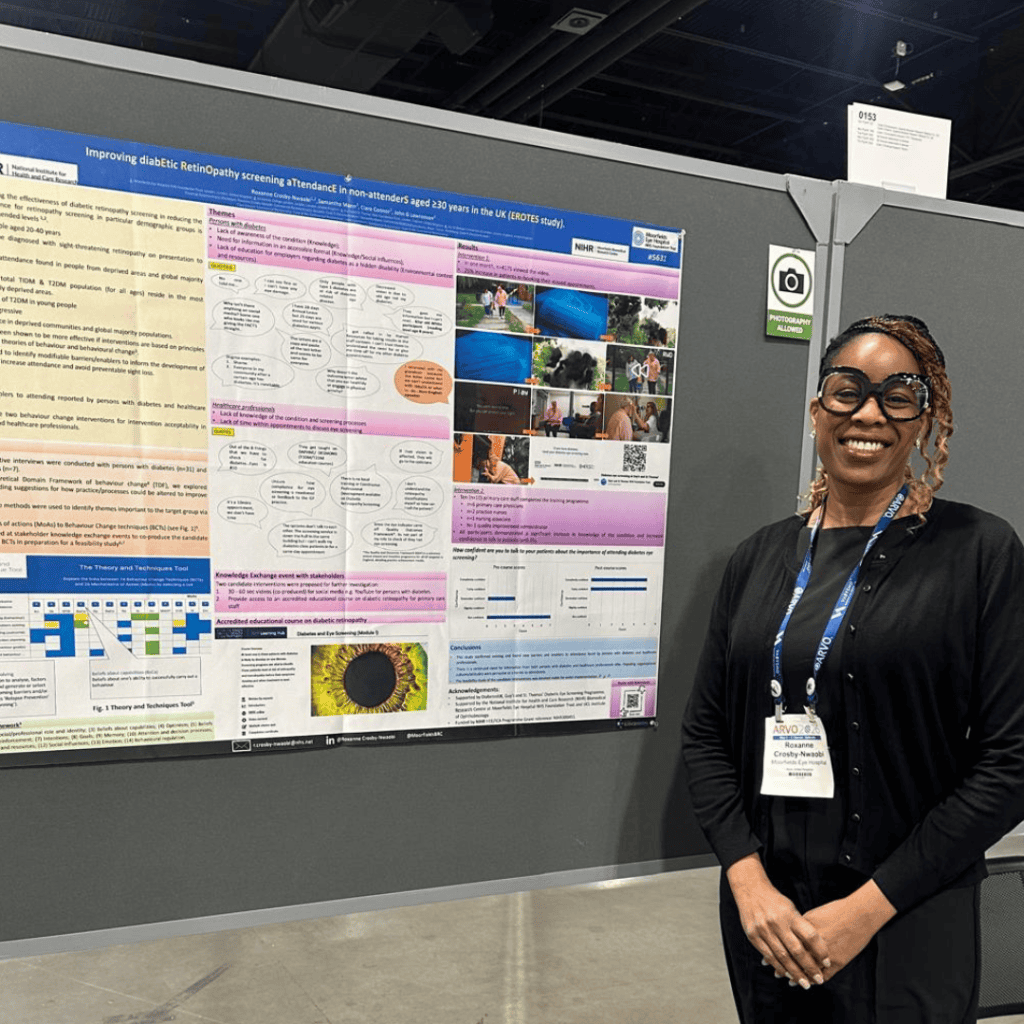
Prof. Roxanne Crosby-Nwaobi: The EROTES study explored ways to improve attendance at diabetic retinopathy screening particularly in younger and more deprived populations. Through qualitative interviews with patients and healthcare professionals, and evaluation of two behaviour change interventions — a social media video and an accredited online education course for GPs — Roxanne’s EROTES study describes promising approaches to improving uptake, with a 25% increase in patients rebooking missed appointments after the video intervention. Roxanne is a PI with the Keane lab, focused on improving health equity.
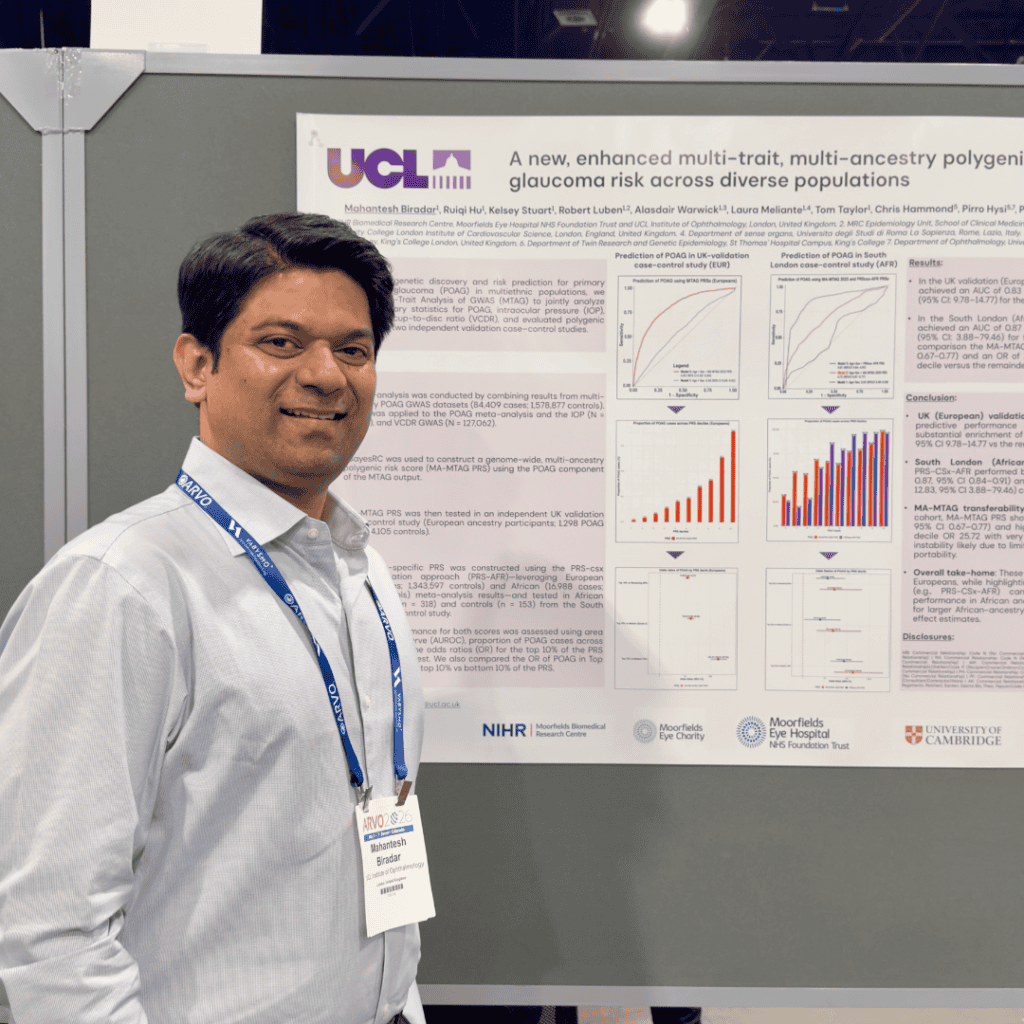
Mahantesh Biradar Iranna: Presented a multi-trait, multi-ancestry genetic model that improves prediction of glaucoma risk across diverse populations and could help identify individuals at highest risk.
Dun Jack Fu: The NIHR Academic Clinical Lecturer investigates how machine learning can predict future vision loss in geographic atrophy using eye imaging. ML-derived biomarkers showed strong agreement with real-world tests, supporting their use in future clinical trials.
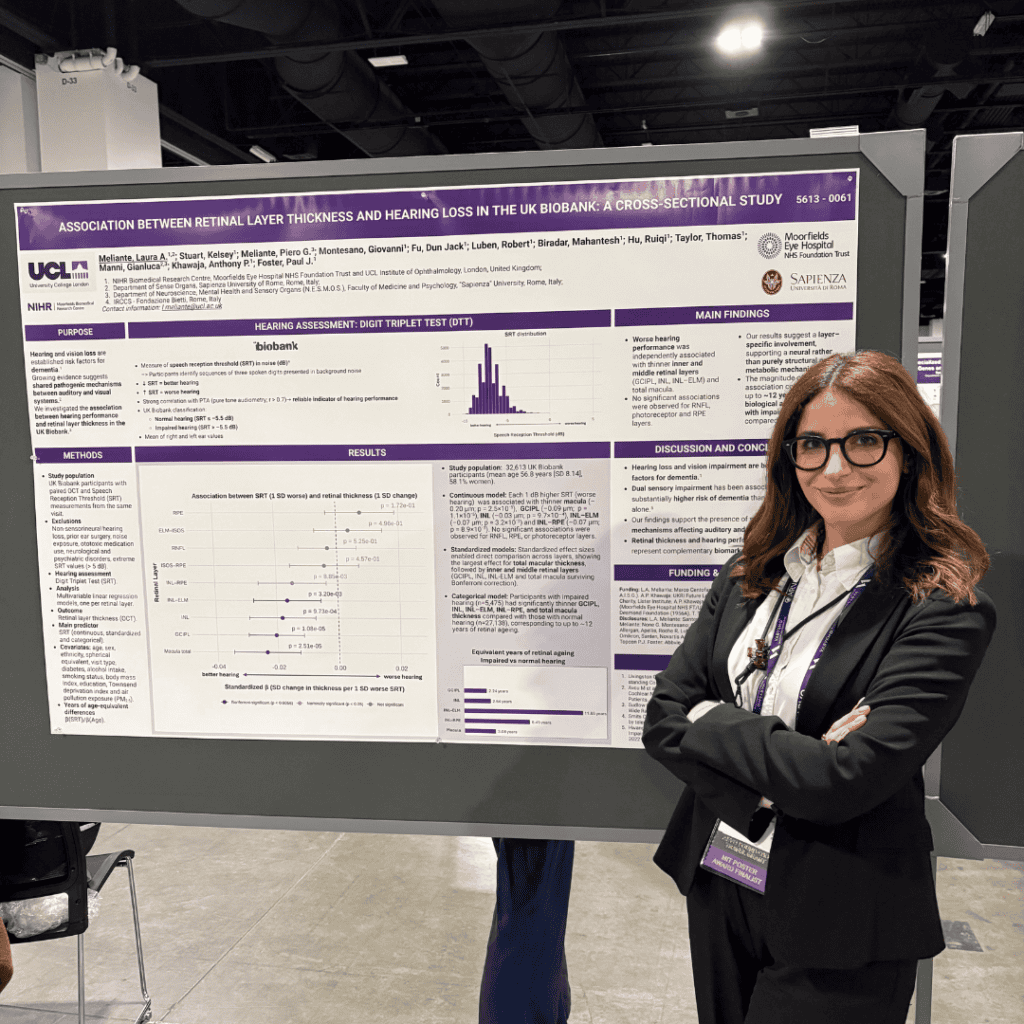
Laura Meliante: Selected as a finalist for the member-in-training (MIT) poster award competition, with her abstract ranked among the top five submissions in its section. Her poster explored the connection between hearing and vision loss, both linked to higher dementia risk. It found that poorer hearing was associated with slightly thinner retinal layers, suggesting that shared neural mechanisms may underlie changes in both senses. She was also awarded an ARVO travel grant.
Skanda Rajasundaram: Presented research on repurposing existing medicines to treat glaucoma using genetic evidence. The findings suggest that statins and fibrates may be beneficial, while other lipid-related treatments may increase risk.
Prof. Annegret Dahlmann-Noor: Delivered a talk on national data in England showing that myopia is common and increases with age. Higher risk was linked to environmental factors such as urban living, deprivation, and lower access to green space and sunlight, particularly in younger children.
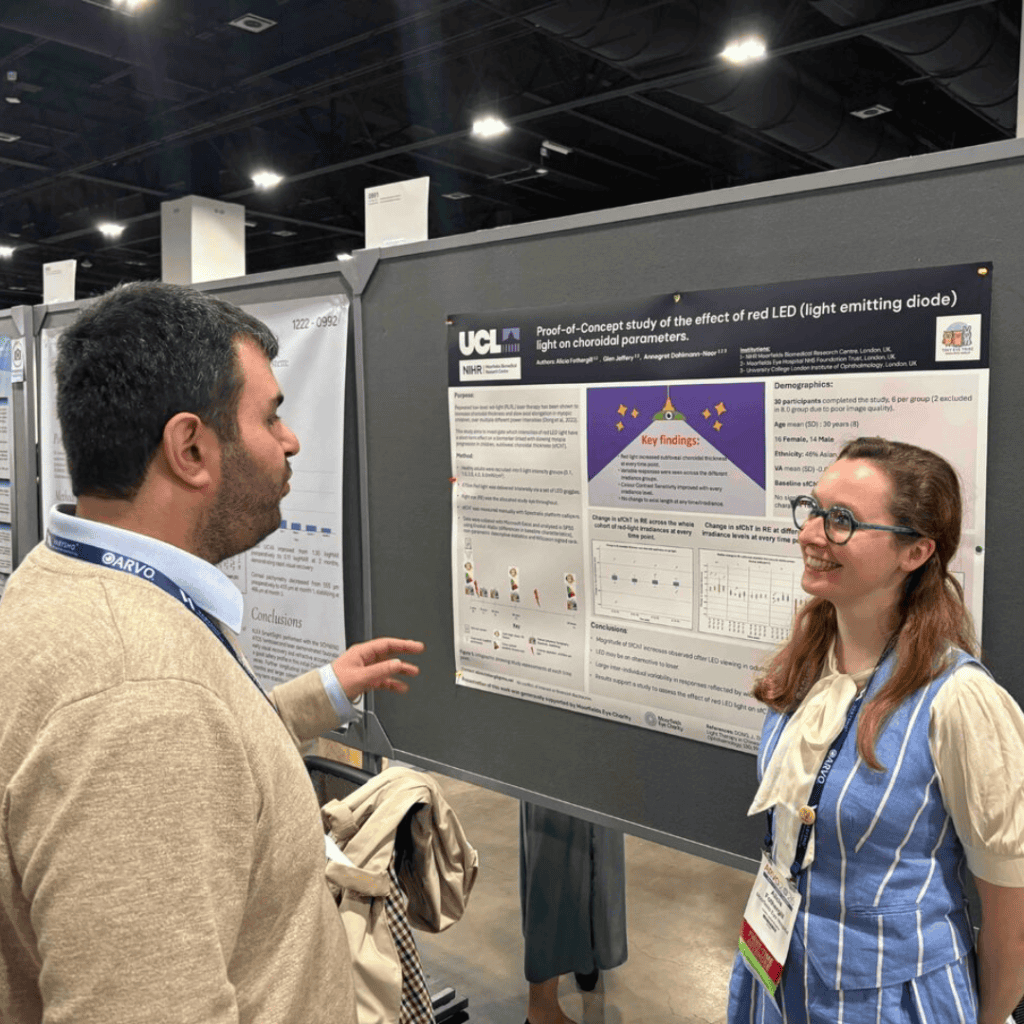
Alicia Fothergill: Showcased her research on red LED light exposure, concluding a need for further investigation. In healthy adults they found rapid and sustained increases in thickness of the layer behind the retina with no effect on photoreceptor sensitivity.
Megan Jacobson: The COSMYC project developed a core outcome set for myopia trials. The work identified 10 key measures to support more consistent and patient-centred research.
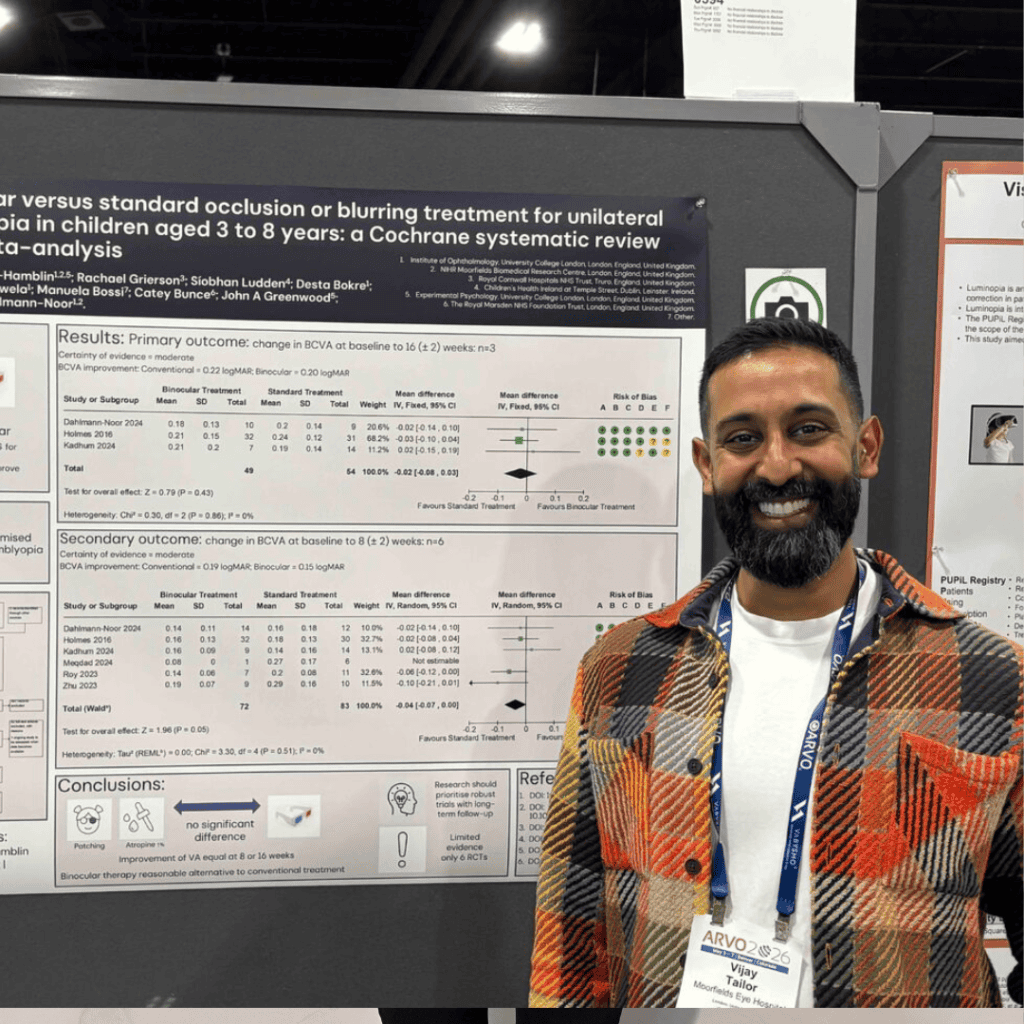
Vijay Tailor-Hamblin: Presented a Cochrane review comparing binocular and conventional treatments for unilateral amblyopia in children. Both approaches showed similar improvements in vision, with binocular therapy emerging as a promising, potentially more acceptable option that requires further research.
Gary Wong: Presented a 3D human model of the RPE–choroid–sclera for studying myopia, using donor-derived and stem cell–derived cells to replicate tissue interactions and improve disease modelling and therapy testing.
Meei Wong: Delivered an evaluation of the OKKO app for home monitoring in children undergoing amblyopia treatment. The study found limited engagement but produced results comparable to standard tests for some measures, highlighting usability as a key barrier.
Isaamuddin Alvi: Showcased that clarity of vision in patients with a rare retinopathy is associated with the PCARE gene. This data will help inform prognostic discussions with patients and future trial design.
Burcu Kandeger: Presented findings in patients with retinitis pigmentosa linked to the CLN3 gene, where over two-thirds showed blurred changes in a key retinal layer on OCT imaging.
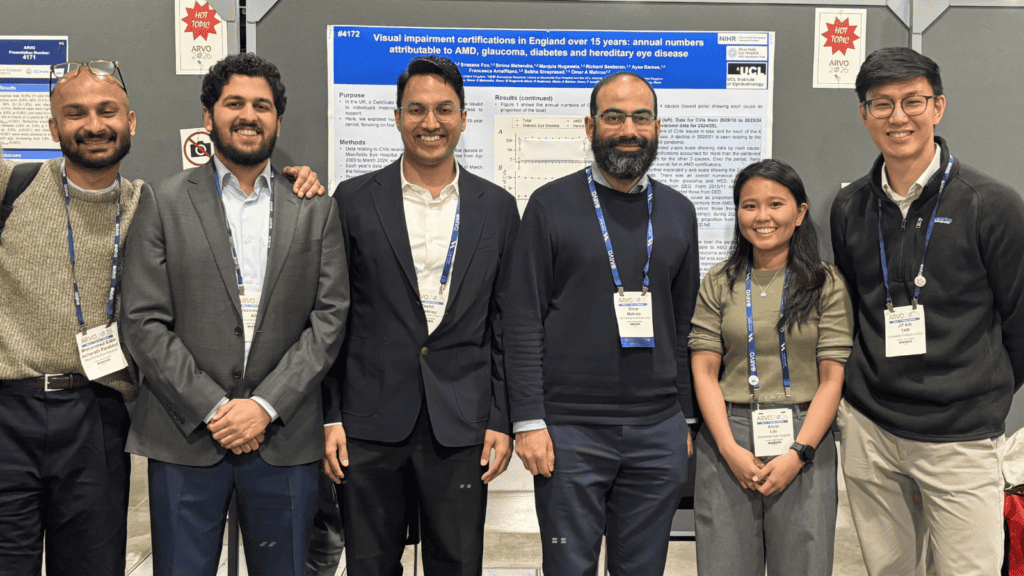
Alicia Lim: Delivered her “Hot Topic” (ARVO category) poster on the analysis of certificate of vision impairment (CVI) data from England over the last 15 years.
Prof. Omar Mahroo: Gave a talk reporting results of the first genome-wide association study (GWAS) of retinal electrical responses.
Mohammed Sabir: Presented findings on an unusual BEST1 gene variant affecting the retina that causes peripheral retinal degeneration and myopia. Unlike typical BEST1 mutations, which lead to macular dystrophy and hyperopia, this change produces a distinct retinal phenotype.
Kai Tan: Presented clinical features from patients with rare CABP4 gene changes, identifying a novel “foveal detachment” at the back of the eye on imaging in some cases.
Toshit Varshney: Presented a poster on a PRPH2 gene variant linked to occult macular dystrophy, a condition affecting central vision. Although clinical examinations often appear normal, retinal imaging reveals characteristic abnormalities associated with this genetic change.
The NIHR Moorfields BRC Eye Hospital Travel Grant Recipient this year was Bhavin Patel. He presented early findings on a keyhole laser procedure (ELIOS) to treat high eye pressure in glaucoma, showing it may reduce pressure and reliance on eye drops while appearing safe.
These ARVO news items are always a joy to piece together, as they give us a chance to reflect on research transforming the lives of patients across our BRC.