A first-in-human clinical trial published in JAMA Ophthalmology has shown that a breakthrough stem cell treatment can improve vision in patients with aniridia-related keratopathy (ARK), a previously untreatable rare genetic eye condition.
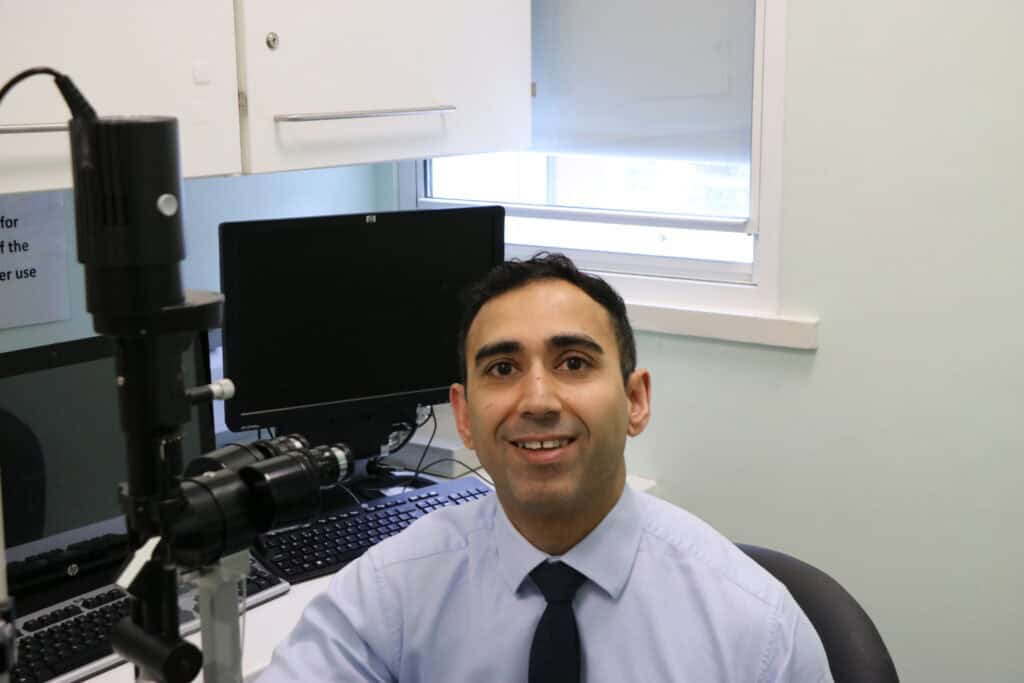
The study was led by Professor Sajjad Ahmad our NIHR Moorfields BRC theme lead for Regenerative Therapy, Lasers, and Medical Devices, and a joint team from Moorfields Eye Hospital and the UCL Institute of Ophthalmology.

Aniridia is an eye surface disorder affecting the limbal stem cells. Limbal stem cells form the border between the sclera (white of the eye) and cornea (the clear area at the front of the eye). Aniridia is mostly an inherited genetic eye development disease, resulting in visual loss and affects one in 40,000 to 100,000 people. It leads to the wrong tissue growing over the cornea, forming a thickening layer that gradually worsens vision. ARK results from a mutation of the PAX6 gene.
The team worked to develop a new collagen scaffold. This was tissue-engineered to deliver limbal epithelial stem cells (cells that act as a living border between the two parts of the eye) and stromal stem cells (connective cells that form the structural framework) to treat the affected area.
Nine patients took part in the trial. One eye of each person received the intervention, the other did not, and acted as a control:
- They started with an average OSS (ocular surface score, which assesses the state of the eye’s surface) of 9.4 in the treated eye, 8.4 in the untreated eye. (Scores of 0-5 are classified as mild, 6-10 moderate and 11-15 severe).
- The treated eyes improved to 5.9 after three months (6.7 after twelve), while the untreated ones had changed very little, being 8.0 after twelve months.
- Importantly, their ETDRS (early treatment diabetic retinopathy study) score had also improved, by an average of 24 letters, or almost five lines of a standard vision chart.

This research was made possible by funding from Medical Research Council, Moorfields Eye Charity and the NIHR Biomedical Research Centre: Moorfields.
Further reading
Read the publication:
Combined Limbal Epithelial and Stromal Cell Transplant for Aniridia-Related Keratopathy
A Nonrandomized Clinical Trial
Read about the researchers involved:
- Prof. Sajjad Ahmad, MEH & UCL
- Emeritus Prof. Julie Daniels, UCL
- Abigail Eve Kaye, UCL & MEH
- Louise Morgan, UCL
- Amanda Vernon, UCL
- Andrew Embleton-Thirsk, UCL
- Hakim-Moulay Dehbi, UCL
- Daniel Sibley, MEH