At our latest Coffee Hour, we were joined by Prof. Glen Jeffery, Professor of Neuroscience at UCL Institute of Ophthalmology, who explained how different types of light affect our health. Hear from one of our patient advisors, David Barton, for his reflections and key takeaways from the talk.
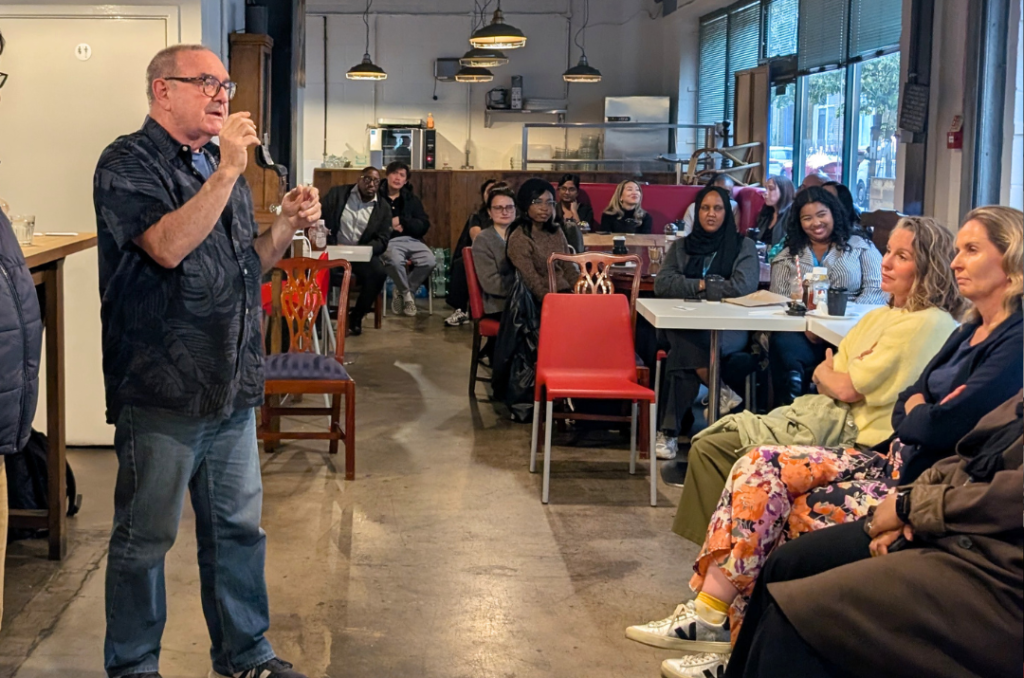
I was first encouraged to join a ‘Coffee Hour’ talk with an assurance I was helping researchers develop their public speaking skills and of course the offer of coffee and cake.
I imagine, like myself, most of the informal audience have a personal connection with eye health and eye care. Together we make a diverse and eclectic mix, but our common interest is evident, for better or worse these are my people.
Today’s speaker, Wednesday 13th May 2026, is Prof. Glen Jeffery describing his research at Moorfields Eye Hospital and UCL Institute of Ophthalmology into how light influences vision and eye health.

I’m constantly intrigued by how often modern science research validates historic wives tales or cultural practices. As a child I occasionally had a rhetorical conversation with my mother, “Go outside and get some sun! Why? Because It’s good for you! Why?”. It turns out my mum was right, who knew.
Glen delivered his explanation to my mother’s assertion in a very clear and accessible way without any need for flip charts, slide shows or visual props. It turns out that all the cells of our body contain what’s known as mitochondria which play a key role in our cell’s wellbeing and operation.
These mitochondria are described rather like batteries which are ‘charged’ when longer wavelength red light falls on our skin and ‘discharged’ by shorter wavelength blue light. When mitochondria have a healthy ‘charge’ of infrared light they function well, utilising sugar from the blood to clear waste products from the body’s cells, all of which is notably good news for the eye and health of the macular.
The professor went on to describe other areas of health research including how ‘charging’ mitochondria with healthy infrared light strongly demonstrates defensive behaviour against the development of Parkinson’s disease.
An unfortunate side effect of our energy efficient lighting these days is that the fluorescent and now LED light bulbs in common use do not shine with longwave red light but do shine with shorter wave blue light. In addition, our phone screens and computer displays share the very same problem.
Modern architects are now starting to consider how to include a full spectrum of natural light into their building design.
The good news for us is that knowledge is power and simply exposing any parts of our body to natural light, even when it’s not sunny, is beneficial to us. There is no need to buy any overpriced gadgetry with exotic and largely bogus health claims, simply step away from those screens and go outdoors which of course has any number of other benefits from movement and interaction with the real world.
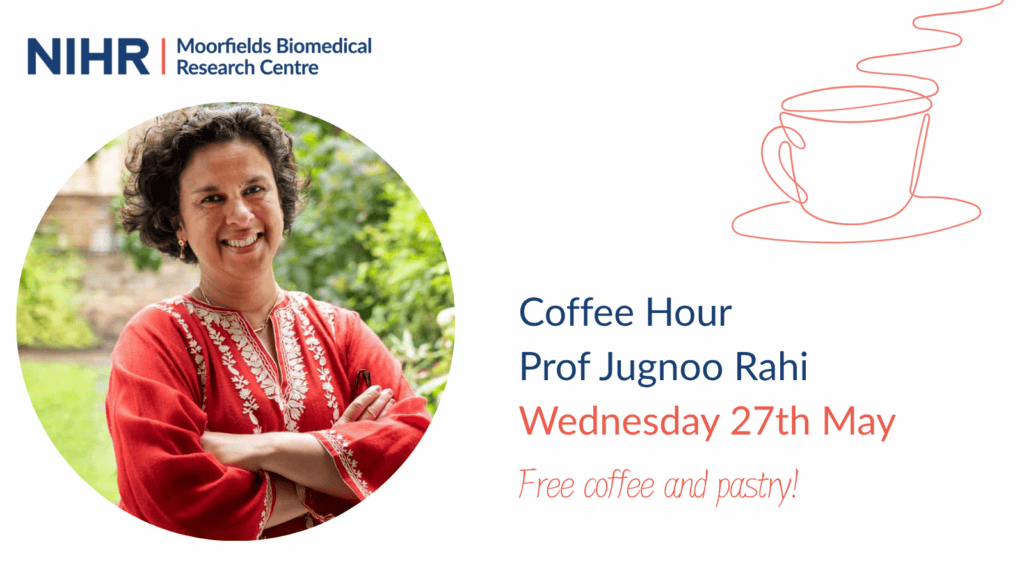
Our next Coffee Hour will take place on the 27th of May with Prof Jugnoo Rahi, who will speak about visual health in children and young people using population health sciences.