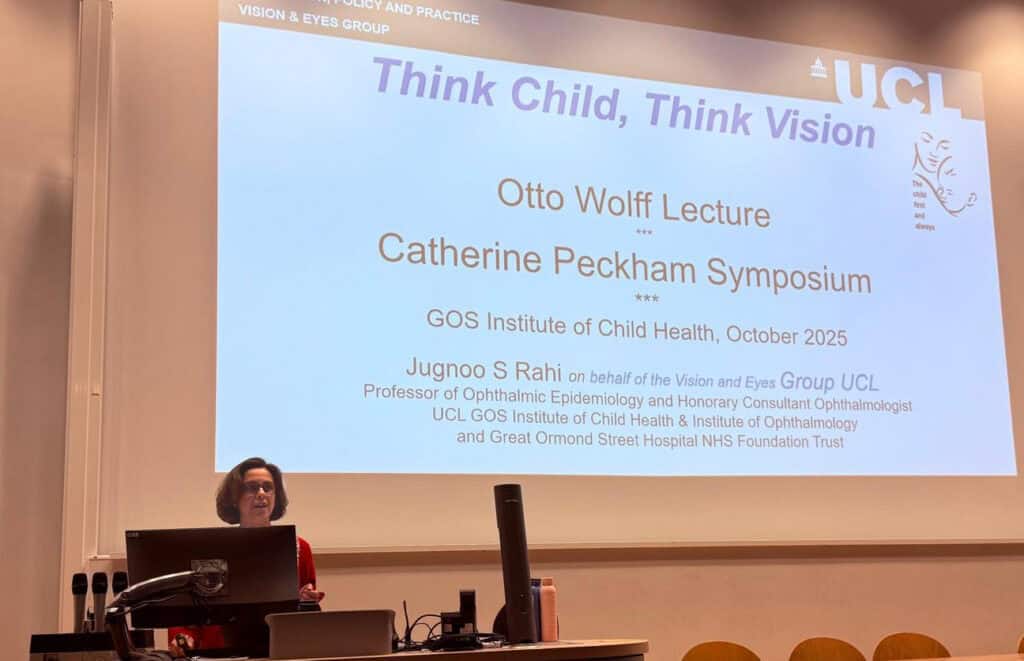
Prof Rahi gave her lecture from her position as leader of the Vision and Eyes Group at UCL, an international multi-disciplinary and multi-professional group with an unusually broad scientific portfolio. The group’s research bridges ophthalmology, paediatrics, public health, and population health sciences. They address both the causes and consequences of rare and common eye diseases; alongside investigating the determinants of visual health and well-being and of visual disability.
In the lecture Prof Rahi laid out the case for the need for better integration of visual health and visual disability into all areas of child an adolescent health, spanning care, services, policy and research. She explained how vision provides robust and accessible models and measures for understanding brain function, development, health over the life course, inequalities, and disability.
For example, the lifelong impact of visual impairment (VI) in the first 1000 days of life. This is the time when a child is growing at a fast rate, with the brain developing in a multitude of ways and learning constantly. A lack of visual information during this time can cause the brain to develop in a different way and leave some areas lacking in growth. The effect of VI at this age is correlated with four times greater chance of mortality by age of 1 year and with significantly worse physical and mental health as well as increased chances of lower educational attainment and being unemployed in mid adult life.
She also updated the audience that The Vision and Eyes Group at UCL is working towards helping the World Health Organisation implement recent key guidance including the Paediatric Package of Eye Care Interventions as well as working on better understanding how to define and characterise vision impairment.
Prof Rahi described VI as being the ‘invisible childhood disability’ and drew on the lived experiences of young people and their families to consider the challenges to ‘making the invisible visible’ which include:
- The lack of awareness amongst health and childhood professionals and the public about childhood VI.
- The complexity of childhood VI which requires multiple professionals across health, education and social care and researchers from many disciplines to be involved, which has created professional and academic silos.
Prof Rahi and the group have recommendations which are to:
- Increase awareness and knowledge by training childhood professionals across disciplines and improving public education into childhood disabilities to include VI.
- Implement existing best practice guidance and initiatives such as key worker Develop new approaches such as cross-training between ophthalmology and paediatrics/child health to upskill all professionals.
- Childhood services to integrate eye health and care in collected health data.
- Changing the key child health indicators to include VI and make it a marker of childhood vulnerability.
- To use the knowledge, treatment and improvement of outcomes in childhood as an exemplar of good child health.
- Include VI in child health research routinely, for example such as a neurodevelopmental outcome, as a form of early childhood adversity.
The talk was followed by a Q&A session where questions ranged from those about the neurodevelopmental pathways and if they can be reversed and re-taught in later life. There was a question around how to recruit clinicians into the paediatric work force which ranks in the top 3 specialties of concern for the Royal College of Ophthalmologists. Another questioner asked about variable implementation due to resource limitations at local authority level of the UK’s National Screening Committee’s recommended vision screening of 4-5 year-olds.
Professor Otto Wolff was Nuffield Professor of Child Health ICH Consultant Paediatrician GOSH, Dean at the Institute of Child Health and President of the British Peadiatric Association.
The lecture named in his honour is UCL’s most prestigious lecture in the field of child health and is is dedicated to advancing knowledge and understanding of child health. The PPP Department combines the Otto Wolff Lecture with its annual e Catherine Peckham Symposium (named in honour of Prof Peckham who founded the PPP Department) to bring together leading researchers, clinicians, and experts to share insights, foster collaboration, and celebrate progress in the field. The theme of this year’s symposium was childhood disability.